



- Key Takeaways
- What Repairs Turn Buyers Away?
- When Fixing Becomes a Red Flag
- Partial or Patchwork Fixes to Big Problems
- Mismatched or Low-Quality Fixes
- Bandaids Backfire
- Over-Improving for the Neighborhood or Price Point
- Repairs Buyers Expect vs. Repairs They'll Accept "As Is"
- Using Price and Closing Cost Credits Instead of Risky Repairs
- What Sellers Should Do Before Listing
- Working With a Real Estate Agent to Plan the Right Repairs
- FAQ: Repairs That Turn Away Buyers
- Should I fix everything my pre-listing home inspector finds?
- Is it better to sell my home as is or do some repairs first?
- When do closing cost credits make more sense than repairs?
- Can obvious DIY work make my home fail a buyer's inspection?
- How do I find an agent who understands inspection and repair strategy?
Repairs That Turn Away Buyers During Home Showings


Published by


Selling your home often means deciding which repairs are worth making before you list—and which ones aren’t. While some improvements can make a home more appealing, rushed, incomplete, or poorly executed repairs can actually make buyers more cautious.
The good news: you don’t need to make your home perfect before selling. The goal is to address problems that could affect safety, functionality, or buyer confidence while avoiding repairs that simply add cost without adding value.
We asked experienced real estate agents what repairs turn buyers away during showings and what sellers should do instead. Their answers point to one consistent theme: buyers aren’t necessarily scared by every repair—they’re scared by signs that a home hasn’t been properly maintained.
Key Takeaways
- Visible signs of deferred maintenance can make buyers wonder what else has been neglected.
- Poorly done DIY repairs can create more concerns than the original problem.
- Water stains, leaks, roof issues, foundation problems, and mold are particularly concerning to buyers.
- Small problems can matter, too, because buyers may interpret them as clues to larger issues.
- Not every repair needs to be completed before listing. Depending on the issue, a seller may be better off disclosing the problem, adjusting the price, or offering a credit.
- The goal isn’t perfection. It’s presenting a home that feels clean, cared for, and honestly priced.
What Repairs Turn Buyers Away?
1. Deferred Maintenance and Signs of Neglect
One of the biggest themes agents identified was deferred maintenance.
Sellers often operate under a simple assumption: fix more, attract more buyers. But, that logic frequently backfires. Buyers today scroll through dozens of listings, comparing high-definition photos and 3D tours. They spot inconsistent finishes, oddly selective upgrades, and cheap patchwork before they ever schedule a showing.
Buyers don’t necessarily expect a resale home to be flawless. But when they see several small problems—damaged flooring, peeling paint, broken fixtures, water stains, odors, or obvious maintenance issues—they may start wondering what they can’t see.
Michael Tessaro, a listing agent with INTERO Real Estate Services in San Jose, California, puts it this way:
“Buyers usually aren’t turned off by one small repair — they’re turned off when a home shows signs of deferred maintenance.”
Tessaro says visible problems can cause buyers to mentally add up potential repair costs and discount the home more than the actual cost of fixing the problem.
The takeaway for sellers: You don’t necessarily need to fix everything. But a home with several obvious maintenance issues can create a perception problem that goes beyond the cost of any individual repair.
2. DIY Electrical, Plumbing, and Structural Repairs
“Terribly done repairs turn buyers off. Do it right or don’t do it at all.”
Joe Bourland | EXP Realty | Phoenix, AZ
Amateur work on major systems is among the most common home inspection repairs that turn away buyers, because it directly impacts safety and insurability. Electrical issues can pose immediate safety risks, and outdated wiring creates safety concerns for buyers that no amount of fresh paint can offset.
Specific DIY electrical red flags that a home inspector will document include:
- Loose or mismatched outlets and switches
- Mixed-brand breakers in the panel
- Missing junction box covers
- Wiring spliced with tape instead of proper connectors
For plumbing, leaky plumbing and broken windows discourage buyers instantly. Inspectors flag makeshift drain traps, mixed clamp styles on PEX lines, and past leaks “fixed” with tape. Plumbing problems can cause significant structural damage over time, and visible patches without proper fittings suggest ongoing risk.
DIY structural fixes are a different story entirely. Temporary jack posts in a 1960s basement, piecemeal sistering of joists, or patched foundation cracks without engineer documentation typically prompt buyers to walk away during the inspection contingency period. Structural issues can completely halt a home sale.
Rather than starting new DIY projects before listing, sellers should either hire licensed professionals with permits where legally required, or price the home as-is and negotiate repair credits after the home inspection.
“Get a qualified structural engineer to provide written repair estimates prior to listing.”
Linda Jennings | Berkshire Hathaway HomeServices / Verani Realty | Salem, NH
Poor workmanship can also raise questions about whether the work was completed correctly or whether additional problems are hiding behind the repair.
What to do instead: Don’t rush into a major DIY project just because you’re preparing to sell. For important repairs, consider hiring a qualified professional and keeping documentation of the work.
3. Cosmetic Cover-Ups
There’s a meaningful difference between cosmetic issues and cosmetic cover-ups. Minor wear like scuffed baseboards is routine maintenance territory. But obvious attempts to hide water damage or cracks drive buyers away fast. Visible water damage and mold can deter potential buyers, and when cover-ups are discovered, they make a material defect seem far worse than honest disclosure would have.
“It’s not the big repairs that scare buyers off, it’s what they can see. A water stain on the ceiling is the worst. Even if the roof was fixed ages ago, buyers assume it’s still leaking scare them off.”
Debbie Sagorin | Coldwell Banker Realty | Newport Beach, CA
Examples that home inspectors and buyer’s agents notice immediately:
- One square of new drywall in a ceiling with faint staining around it
- Freshly painted basement walls on only one side
- Brand-new trim around a window with a visibly wavy sill
- Significant mold evidence masked by fresh primer
During the inspection, these cosmetic band-aids almost always confirm moisture intrusion, foundation movement, or roof leaks. Buyers then request repairs or terminate during the contingency period. Buyers can terminate the contract during the inspection contingency period, so a cover-up that gets caught doesn’t just weaken your position – it can end the deal entirely.
When buyers see mismatched paint patches dated right before listing, they interpret it as a signal the seller is hiding recent problems. Better strategies include fully addressing the underlying issue with licensed pros, completing repairs instead of partial patches, or clearly disclosing known past issues and pricing the home accordingly.
The better approach: Fix the underlying problem first. If a previous problem was properly repaired, keep documentation that can help demonstrate what happened and how it was resolved.
4. Mold and Previous Water Damage
Mold or visible discoloration can be an especially strong buyer deterrent.
One agent surveyed, Andy Hargreaves of Prime + Property in Plymouth, Michigan, said:
“Mold/discoloration. As soon as buyers hear that, 90% of them want no part of the deal even with remediation.”
His recommendation is to complete a pre-sale inspection, correct identified issues, and document the repairs.
That doesn’t mean every home needs a pre-listing inspection. But if you’re concerned about an existing moisture or mold issue, talk with your real estate agent about whether an inspection or professional evaluation makes sense before listing.
5. Repairs That Look Unfinished
A repair doesn’t have to be expensive to hurt buyer confidence.
Jay Thomas of eXp Realty in Houston, Texas, points out that even small issues can make buyers suspicious:
“Even smaller repairs like broken fixtures, dripping faucets or strong pet odors can make buyers wonder what other bigger ticket items are the sellers hiding.”
This is why a pre-listing walk-through can be valuable. Walk through the home as if you’re seeing it for the first time and look for the things you may have stopped noticing:
- Dripping faucets
- Sticky doors
- Broken cabinet hardware
- Damaged flooring
- Burned-out light bulbs
- Peeling or scuffed paint
- Dirty HVAC returns
- Strong pet or other odors
- Visible stains
- Loose fixtures
These aren’t necessarily expensive repairs. But taking care of them can make the home feel better maintained.
6. Mold, Cracks, and Other Issues Buyers Can’t Easily Price
Some repairs are particularly concerning because buyers don’t know how much they’re going to cost.
David Stafford of 360 Ventures Real Estate in Albuquerque, New Mexico, says repairs that are “unique, uncertain, or hard to estimate”—such as sewer line repairs, HVAC replacement, or radon treatment—can turn buyers away because they may assume the worst-case cost.
He also notes that unresolved repairs can create closing delays.
That’s an important consideration when deciding whether to repair something before listing.
The more uncertain the problem, the more valuable good documentation can become. A professional evaluation, estimate, inspection report, or repair record can give buyers something concrete to consider instead of leaving them to guess.
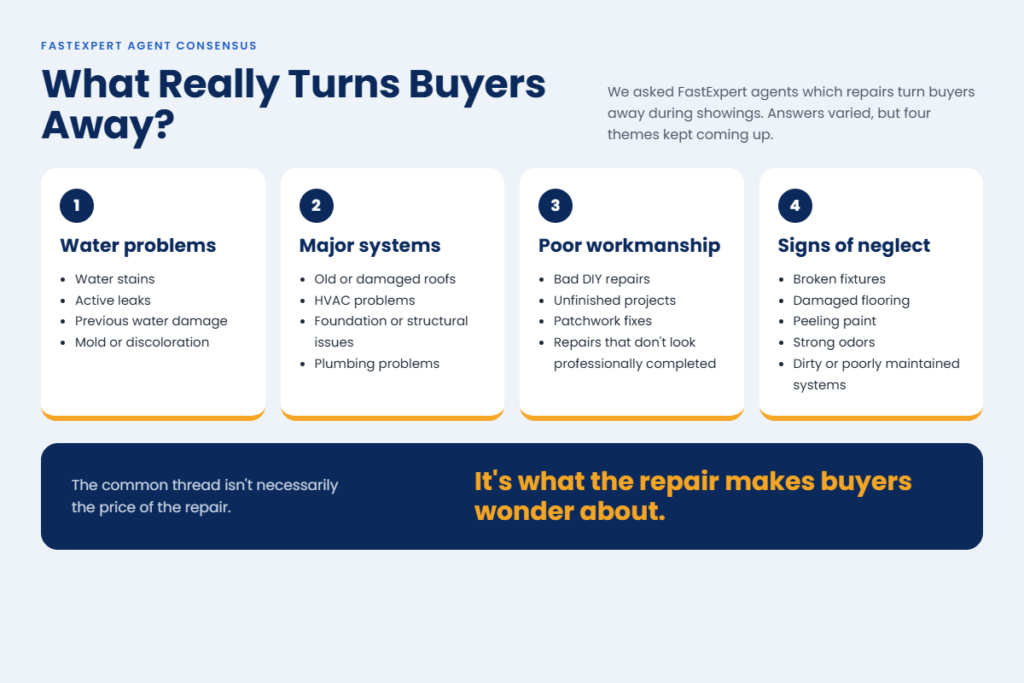
When Fixing Becomes a Red Flag
Buyers read repairs as clues about how the home was maintained. Heavy recent work in one area paired with visible neglect elsewhere feels like a cover-up, not an upgrade. Small problems can lead buyers to assume larger hidden issues, and deferred maintenance suggests a house has not been well cared for.
The emotional reaction is immediate. A freshly painted single wall, a brand-new fixture next to a dated vanity, or components installed days before listing all prompt the same thought: “What was so bad that they had to rush this?” Prospective buyers prioritize safety and functionality in their evaluations, and inconsistency triggers suspicion rather than confidence.
Consider a 1998 home where only one bathroom has been hastily updated while everything else shows normal wear. Buyers don’t see a generous upgrade – they wonder what leak or mold problem forced the work. Their buyer’s agent will often advise extra caution, and the seller’s negotiating position weakens before the first offer even arrives.
Partial or Patchwork Fixes to Big Problems
Buyers prefer one documented, complete fix over multiple partial ones. Piecemeal roof or foundation repairs make them assume future repair costs and uncertainty.
“Consider having a professional roof inspection done before further showings. If needed, pay for the roof prior to closing.”
Kelley Blackburn | Coldwell Banker Realty | Lakeland, FL
Foundation cracks and roof damage are major red flags for buyers, and roofing damage can lead to leaks and mold if left partially addressed.
Roof examples that concern buyers:
- Replacing a few visible shingles on a 25-year-old roof with curled tabs elsewhere
- Patching around one vent but leaving others unsealed
- Installing a new ridge cap while ignoring soft decking
Foundation issues show up as interior wall cracks freshly caulked, uneven floors with just a couple of new shims, or exterior cracks filled with epoxy but no engineer’s report in the disclosures.
Pest or termite damage can frighten off buyers in these same areas, and pest infestations can indicate serious structural problems beneath the surface.
Drainage “fixes” also worry buyers: a single new downspout extension while other gutters still dump near the foundation signals an incomplete approach.
With big-ticket items, the best approach is either a documented, professionally completed repair with a transferable warranty, or fully transparent disclosure plus a price adjustment or closing cost credit to the buyer. Repair costs for foundations alone can range from $2,200 to over $30,000.

Mismatched or Low-Quality Fixes
Cheap cosmetic updates done right before listing can make buyers feel they’re paying for the seller’s “quick flip,” not long-term quality. Cosmetic issues like dirt and outdated interiors affect buyer perception, but so do jarring partial upgrades that create more work rather than less.
Common examples that backfire:
- Installing entry-level vinyl plank only in the living room while leaving stained carpet in bedrooms
- Swapping kitchen cabinet doors but leaving dated laminate counters and original hinges
- Combining trendy black hardware in one bathroom with 1990s brass everywhere else
- Mixing cool-toned gray paint in a single room with warm beige throughout
Buyers prefer neutral spaces that they can customize themselves. When they see partial makeovers, they calculate the cost to unify the design – and that math often turns them away even though the improvements are technically “new.” Poor curb appeal can negatively influence first impressions in the same way: if the exterior is neglected while one interior room sparkles, the contrast hurts rather than helps.
The better approach is either a small number of cohesive, high-impact fixes – consistent neutral paint throughout, updated lighting in main areas – or skipping scattered mini-upgrades and adjusting the sales price to reflect original condition.
Bandaids Backfire
Buyer’s agents and every home inspector are trained to recognize cosmetic band-aids, unpermitted work, and what the industry calls “lipstick on a pig.” When they flag these in an inspection report, it doesn’t just raise questions – it kills trust. Research shows that 86% of inspections uncover at least one issue, and approximately 60–70% flag electrical deficiencies alone. The question isn’t whether problems will surface. It’s whether your repairs look like solutions or cover-ups.
Think of repairs in three buckets: must-fix for safety and financing, nice-to-have, and “backfire repairs” that hurt perceived value or raise red flags.
Over-Improving for the Neighborhood or Price Point
Some home repairs and upgrades provide almost no return in certain areas and can even turn buyers away when the home no longer matches the neighborhood. Excessive customizations may decrease a home’s selling potential rather than enhance it.
Consider adding a $70,000 chef’s kitchen with a 48-inch range in a subdivision of $320,000 starter homes. Buyers shopping that purchase price range often prefer a clean, functional home and would rather keep costs (and property taxes) lower than pay for luxury finishes they didn’t choose. Significant delays due to renovations can negatively affect sales timelines too.
Appraisers adjust value based on comparable sales. If yours is the only house in the area with luxury finishes, the appraisal may still be tied to neighborhood norms, creating appraisal gaps that scare off financed buyers. HVAC system failure suggests immediate costs to buyers, but a brand-new $15,000 HVAC system in a neighborhood where comps have original equipment may not add equivalent value to the contract.
Sellers should consult a local listing agent – such as one matched through FastExpert – who can run a comparative market analysis and show which upgrades actually help homes sell faster in their ZIP code.
Repairs Buyers Expect vs. Repairs They’ll Accept “As Is”
Common home repairs can fall into major structural issues and smaller maintenance items. Understanding which category each fix belongs to determines whether it’s a top priority or something buyers will accept with proper pricing.
Repairs that are typically smart to address:
- Loose stair handrails and missing GFCI outletsnear water
- Broken window locks or actively leaking plumbing traps
- Safety concerns like missing smoke or carbon monoxide detectors
- Any item that FHA loans require sellers to fix specific safety issues before closing
Items most buyers tolerate as is:
- Small nail holes and minor wall dings (normal wear)
- Slightly worn hardwood
- Original but clean appliances that still function
- Cosmetic items like dated light fixtures
Different loan types can make this a different story. FHA and VA financing may require certain repairs pre-closing, such as peeling exterior paint on a 1978 home or trip hazards. Conventional buyers can often accept the home as is with a credit. Sellers can legally refuse all repair requests after inspection, and in states like Indiana, sellers are not required to make any repairs post-inspection.
Sellers must keep the property in substantially the same condition until closing day, but that doesn’t mean they need to handle repairs for every line item. Work with your seller’s agent to sort the inspection report into categories: “must fix before listing,” “likely to be negotiated,” and “disclose and leave alone.”
Using Price and Closing Cost Credits Instead of Risky Repairs
For many non-safety items, it’s smarter to adjust price or offer a closing cost credit than to rush repairs that may not match the buyer’s request or preferences. Buyers can request a credit instead of direct repairs if needed, and buyers can negotiate alternative solutions if the seller refuses repairs directly.
“If you’re selling your home, but the roof and HVAC systems are at the end of their life, price your home lower.”
Jenniffer Taylor | Pacific Sotheby’s International Realty | San Diego, CA
A closing cost credit works like this: at closing, the seller pays part of the buyer’s allowable costs within lender limits, effectively giving the buyer money to handle home repairs with their own contractor after they own the home. Inspection reports help buyers focus on material defects during negotiations, making credits a practical tool for resolving repair requests without delaying the deal.
Credits work especially well for:
- Dated but functional kitchen countertops
- An older HVAC system still working but near end of life (HVAC systems are expensive to replace and often flagged)
- A worn roof that doesn’t yet leak but will need replacement in a few years
- A water heater approaching its expected lifespan
Buyers and their buyer’s agent often prefer credits so they can choose materials, contractors, and timing rather than inheriting the seller’s low-bid work. Before listing, sellers should talk with a local agent about realistic credit ranges and how to present them during inspection negotiations.

What Sellers Should Do Before Listing
Before spending thousands of dollars on repairs, walk through the home with an experienced local real estate agent.
Ask:
- Which problems are most likely to turn buyers away?
- Which repairs will actually improve the home’s marketability?
- Which repairs are unlikely to provide a good return?
- Should we repair this problem, disclose it, or price around it?
- Would a buyer prefer a credit instead?
Your agent can help prioritize the list based on what buyers are responding to in your local market.
Jan Copeland of Short Pump Luxe Realty near Richmond, Virginia, emphasizes the importance of preparing the home so buyers feel confident about what they’re seeing:
“When the home shows clean, light-filled and fresh, they are willing to pay top dollar. Otherwise, they will keep looking.”
Working With a Real Estate Agent to Plan the Right Repairs
Deciding what to repair, what to leave as is, and when to use credits is best done with a knowledgeable local listing agent who sees dozens of inspection reports each year.
“The goal is not perfection — it’s presenting the home so buyers focus on its value instead of its problems.”
Michael Tessaro | INTERO Real Estate Services | San Jose, CA
The right agent can walk through the home, point out which repairs would actually turn away buyers in that specific city or school district, and which inexpensive fixes will boost first impressions.
Experienced agents coordinate with home inspectors, licensed contractors, and stagers to build a prioritized prep list – not a random collection of projects. They understand contract terms, local market expectations, and how to protect your best interest during negotiation.
FastExpert is a free way for sellers to compare multiple local agents by sales history, reviews, and experience with inspection negotiations and closing cost credits in their price range. Connect with an agent early – ideally 60–90 days before listing – so you have time to choose the right repairs without rushing into backfire projects. In most transactions, the sellers who avoid over-repairing and under-disclosing are the ones who close fastest and at the strongest price.
FAQ: Repairs That Turn Away Buyers
These FAQs address common questions sellers face before listing, focusing on practical scenarios not fully covered above.
Should I fix everything my pre-listing home inspector finds?
No. A home inspection is not a mandatory to-do list. Fix clear safety issues, simple low-cost cosmetic items that make a big visual impact, and anything likely to affect safety or be flagged by most lenders. Many minor items – slightly loose outlets, small caulk gaps, normal wear on a 2015 roof – can be left alone and handled through pricing strategy or negotiation. Sellers can decline repair requests after a home inspection, and in states like Indiana, silence from sellers on repair requests is treated as acceptance, so always respond in writing. Create three lists with your listing agent: “must fix,” “consider negotiating,” and “disclose and leave as is.”
Is it better to sell my home as is or do some repairs first?
Selling a property as is still allows buyers to get a home inspection and request home inspection repairs – it simply signals that the seller believes the price reflects current condition and does not plan to make repairs beyond what’s legally required. In a hot seller’s market, a clean, honestly priced as-is sale can work well. In slower markets, doing selective high-impact repairs like paint, minor exterior routine maintenance, and obvious safety fixes often attracts more buyers. Earnest money and purchase agreement terms still apply. Get market-specific advice from a local agent matched through FastExpert before committing to a full as-is approach.
When do closing cost credits make more sense than repairs?
Credits typically work best for bigger discretionary items: replacing aging but functioning systems, cosmetic upgrades the buyer may want to personalize, or projects that would delay closing if the seller tried to complete them. Lenders cap closing cost credits based on loan type and down payment, so sellers and buyers must coordinate with the lender to stay within allowable limits. Offering a credit can be especially attractive if the seller is short on time before a firm closing date, and it avoids the risk of building code violations from rushed, unpermitted work. Buyers can request a closing cost credit instead of repairs in virtually any negotiation.
Can obvious DIY work make my home fail a buyer’s inspection?
Inspectors don’t technically “fail” houses, but they do document safety hazards, code violations, and questionable work. DIY electrical, plumbing, or structural work often triggers requests for contractor estimates, specialist reports, and further evaluation. Excessive DIY notes in an inspection report typically cause buyers to request licensed repairs, large credits, or to walk away during the inspection contingency, especially if they’re using FHA or VA financing. Structural concerns and electrical systems done without permits are the most common deal-killers. If your home has extensive DIY work, consult a local agent about which items to professionally correct before listing and how to disclose the rest honestly.
How do I find an agent who understands inspection and repair strategy?
FastExpert lets sellers enter their city or ZIP code and instantly see multiple experienced listing agents, along with transaction counts, reviews, and recent sales data. Ask potential agents specific questions: How do you handle repair requests after inspection? When do you recommend a price reduction versus a credit? Can you share recent local examples? The right agent will protect you from over-repairing and from cutting corners on major issues that matter to buyers and lenders. Finding an agent with strong inspection negotiations experience can be the difference between a smooth closing and a collapsed deal.


