
- Quick Answer: How Do You Know If a Real Estate Agent Is Trustworthy?
- 1. Verify the Agent's License and Credentials
- 2. Look at the Agent's Recent Experience
- 3. Read Reviews—but Look for Patterns
- 4. Ask About Local Market Experience
- 5. Pay Attention to How the Agent Communicates
- 6. Ask How They Handle Difficult Situations
- 7. Ask for a Strategy—Not Just a Sales Pitch
- 8. Understand How the Agent Gets Paid
- 9. Review the Agreement Before You Sign
- 10. Watch for These Real Estate Agent Red Flags
- Your Trustworthy Real Estate Agent Checklist
- Questions to Ask Before Hiring a Real Estate Agent
- How Many Real Estate Agents Should You Interview?
- What Makes a Real Estate Agent Trustworthy?
- Find a Real Estate Agent You Can Trust
How to Find a Trustworthy Real Estate Agent: Questions, Red Flags & More


Published by

Click here to browse our Real Estate Agent Directory and contact top-rated agents in your area!

Your real estate agent can make or break your real estate transaction. Therefore, you need to find a trustworthy agent who is incredibly knowledgeable, a smart negotiator, and your biggest advocate. Whether you’re buying your first home, selling a longtime property, or moving to a new market, you’re trusting someone to help guide one of the biggest financial decisions you’ll make.
So how do you know if a real estate agent is trustworthy?
You don’t have to rely on a gut feeling or simply choose the agent with the most sales or the most impressive website. Instead, take some time to evaluate an agent’s credentials, experience, reviews, communication style, local knowledge, and approach to your goals.
The right agent won’t just tell you what you want to hear. They’ll explain your options, point out potential challenges, answer your questions clearly, and help you make informed decisions.
Quick Answer: How Do You Know If a Real Estate Agent Is Trustworthy?
A trustworthy real estate agent should be able to:
- Verify their active real estate license
- Explain their experience in your specific market
- Provide information about recent transactions and relevant experience
- Give you clear answers about how they communicate and work with clients
- Explain their compensation and any agreement you’ll be asked to sign
- Discuss both opportunities and potential challenges
- Avoid making unrealistic promises or guarantees
- Listen to your goals instead of pushing you toward their preferred strategy
- Give you time to ask questions and make a decision
- Be transparent about potential conflicts of interest
The best way to evaluate an agent is to compare a few qualified candidates rather than choosing someone based on one credential, review, or recommendation.
1. Verify the Agent’s License and Credentials
Start with the basics: Make sure you’re working with a properly licensed real estate professional.
Real estate licensing is handled at the state level, so the process for checking an agent’s license varies by location. Most states provide an online license lookup tool through the state real estate commission or regulatory agency. Look for an active license and, where available, information about disciplinary actions or other regulatory history.
In addition, the NAR has a comprehensive list of certifications and what they are for to help you better understand what each certification means.
What about the term “REALTOR®”?
“Real estate agent” and “REALTOR®” aren’t interchangeable terms.
A real estate agent is a licensed professional who can help people buy or sell real estate. REALTOR® is a membership designation for a real estate professional who belongs to the National Association of REALTORS® and is subject to its Code of Ethics.
Being a REALTOR® can be one piece of information to consider, but it shouldn’t be your only test of whether an agent is right for you.
A better question is: Does this particular agent have the experience, communication style, knowledge, and approach that fit my needs?
2. Look at the Agent’s Recent Experience
Years in real estate can provide useful context, but experience isn’t just about the number of years someone has held a license.
Ask about recent, relevant experience.
For example:
- How many buyers or sellers have you worked with recently?
- How many transactions have you completed in my area?
- How familiar are you with my neighborhood?
- Do you regularly work with homes in my price range?
- Have you worked with clients in a situation similar to mine?
- Are you primarily a buyer’s agent, listing agent, or do you work with both?
An agent who has completed hundreds of transactions over a long career may be an excellent choice. Years of experience negotiating and managing hundreds of transactions can provide insight for a strong and successful transaction.
However, an agent with fewer years in the business could also be a great fit if they have strong recent experience in your particular market and situation. In addition, young agents are often eager to build a reputation and can have an energetic approach to your transaction.
The goal isn’t to find the agent with the biggest number.
It’s to find the agent with the right experience for you.
Talk to Past Clients
Personal conversations with past clients can allow you to dig deeper into a real estate agent. This doesn’t need to be a formal interview. A quick email or text can help you understand the agent’s background and how they operate.
It can also give you a chance to ask questions you may have been hesitant to ask the agent directly. You can get to what the client truly thought of the agent, which goes beyond the public reviews.
Even the agent’s reaction to you asking to connect with clients can be revealing. A trustworthy real estate agent will happily connect you with past clients because they know they did an excellent job.
>>LEARN: What to Expect When You Meet Your Realtor.
3. Read Reviews—but Look for Patterns
Before we choose a restaurant, we look at online reviews. And isn’t it even more important to investigate and read reviews of the person who’s going to conduct one of the biggest financial transactions of your life?
We all know reviews can be very revealing, but they can also be misleading. So, it’s important to look beyond the star rating and to find patterns in the reviews. Stories about personal transactions can be even more meaningful and insightful.
>>READ: Verified Reviews and Ratings of Agents in Your Target Area
Positive signs include:
- Clients mention strong communication
- Reviews describe specific experiences rather than generic praise
- Clients say the agent explained the process clearly
- Reviews mention the agent’s ability to solve problems
- Recent clients describe feeling informed and supported
- The agent responds professionally to feedback
Pay attention to potential red flags:
- Multiple clients mention poor communication
- Several reviews describe feeling pressured
- Clients repeatedly say expectations weren’t met
- Reviews mention problems that went unexplained or unresolved
- The agent responds defensively or unprofessionally to criticism
One negative review doesn’t necessarily mean an agent is untrustworthy. Real estate transactions can be complicated, and even good professionals can have an unhappy client.
And remember that reviews are just one piece of the picture. Combine them with an agent’s experience, credentials, references, and your own conversation with them.
Trust Your Gut
Only you really know how a person or an interaction makes you feel. If you don’t feel excited or confident after an interview with a potential real estate agent, that isn’t a good sign.
There are so many agents out there that are working hard to build their business that it isn’t worth giving yours to someone you don’t feel good about. Keep interviewing. Eventually, you will find an agent you can trust and feel good about.
4. Ask About Local Market Experience
While the National housing market can reveal general trends, real estate is local. The country may be flatlining, but your target area may be thriving. That’s why it’s essential to connect with a top local agent. An agent who knows your city, or better yet, your neighborhood, may understand things that aren’t obvious from national housing statistics or an online home search.
Ask these questions about the agent’s local experience:
- How many transactions have you completed in this area recently?
- What are you seeing in this neighborhood right now?
- What types of homes are selling quickly?
- What challenges are buyers/sellers facing here?
- What would you expect to be difficult about my transaction?
- What factors are most important when pricing a home in this market?
Really listen to how the agent answers. Does the agent sound confident and have answers that easily come to mind? Or do you sense that the agent is grasping for answers?
A trustworthy real estate agent shouldn’t need to pretend that every neighborhood is perfect or that every home will sell immediately.
The agent should also be transparent about their knowledge of an area. A lack of knowledge about a specific neighborhood doesn’t mean they’re not a good fit, as long as they are honest about what they know.
5. Pay Attention to How the Agent Communicates
You’re going to spend a lot of time with your real estate agent. Oftentimes it takes 3-6 months, or even longer, to buy a home. During that time, you’ll communicate frequently with your agent and spend hours together.
Before you even ask the details of how they communicate logistically, you need to determine if you even like this person. It may sound harsh, but individuals connect on different levels; that’s the honest truth.
It’s important to find an agent that understands you and that you can be honest with. Oftentimes, agents need to know personal information that you aren’t publicly sharing, like a change in relationship or expansion of your family. You need to find a trustworthy real estate agent that you’re comfortable with.
But just because you vibe with the real estate agent doesn’t mean they’re automatically the one. You also need to ensure that they are a professional communicator and will meet your expectations for how they communicate.
Ask:
- What’s your preferred method of communication?
- How quickly do you typically respond?
- Will I communicate directly with you?
- If you’re part of a team, who else will be involved?
- How often will you update me?
- What happens if I have a question outside normal business hours?
- How do you handle urgent situations?
There’s no single right communication style. It depends on what your expectations are. Before you meet with the agent, think through how often you’d like updates and how you prefer your updates. Some clients want frequent text updates. Others prefer scheduled phone calls or email.
The important thing is finding an agent whose communication style matches your expectations. And pay attention to the communication you receive before you’ve hired them. It’s essential to take your time and hire the agent that is best for you.
>>ASK: Essential Interview Questions to Ask An Agent
6. Ask How They Handle Difficult Situations
Here’s a question that can tell you a lot about an agent:
“Can you tell me about a transaction that didn’t go according to plan and how you handled it?”
Real estate transactions don’t always go smoothly. In fact, most real estate transactions have bumps along the way.
An inspection can uncover a major problem. An appraisal can come in below expectations. A buyer’s financing can fall through. A seller may have unrealistic expectations about price. A deal can even fall apart at the last minute.
Even if there are no major issues that arise, in real estate, there are always negotiations involved in determining the price and concessions. It’s essential to get a picture of how a real estate agent handles tough situations and any negotiations.
You don’t need an agent who promises that nothing will go wrong. You need someone who can help you navigate problems when they do.
Listen for whether the agent:
- Takes responsibility
- Communicates clearly
- Explains options
- Stays calm under pressure
- Knows when to bring in another professional
- Focuses on solutions rather than blame
Sometimes, an agent’s approach to a difficult situation tells you more than a list of successful transactions.
7. Ask for a Strategy—Not Just a Sales Pitch
A good agent should be able to explain how they would approach your specific situation in your specific housing market. Maybe in your first conversation the agent will sell you on their abilities and how successful they are.
Take time after the conversation to think back on their approach. Did the agent sell you on themselves, or your specific situation? Did the agent take time to understand your position and develop a plan around your needs?
If you’re selling, ask:
- “How would you determine the right listing price for my home?”
- “What would you recommend I do before listing—and what wouldn’t you spend money on?”
- “How would you market my home?”
If you’re buying, ask:
- “How would you help me evaluate whether a home is fairly priced?”
- “What are your negotiation tactics?
- “What should I be watching for during the buying process?”
Look for specific, evidence-based answers rather than sweeping promises. Be cautious if an agent guarantees a particular sales price, promises that your home will sell in a certain number of days, or makes claims that sound too good to be true.
A trustworthy agent should be comfortable saying:
“It depends.”
Real estate rarely comes with guarantees.
8. Understand How the Agent Gets Paid
Compensation is an important part of choosing an agent, and the way agents are compensated has changed in recent years.
Agent compensation is negotiable and can vary by agent, brokerage, market, transaction, and services provided. There isn’t one universally required commission rate.
While it can feel uncomfortable to bring up payment and negotiate, both you and the agent should have open, transparent discussion around how the agent gets paid and what the rate is.
If you’re buying a home, ask the agent to explain:
- How they are compensated
- What services are included
- What compensation you’ll agree to
- Whether the seller may contribute toward your agent’s compensation
- What happens if the seller’s contribution doesn’t cover the amount you’ve agreed to
- How long your buyer agreement lasts
- Whether and how you can terminate the agreement
For MLS participants covered by the NAR practice changes, buyers must enter into a written agreement before touring a home, and the agreement must clearly address compensation. The compensation amount or rate must be objectively ascertainable, and the agreement must disclose that broker compensation is negotiable and not set by law.
The exact requirements and forms can vary based on state law and the brokerage involved, so ask the agent to walk you through the agreement before signing.
If you’re selling, ask:
- What services are included in your compensation?
- How is your compensation structured?
- Will I be responsible for paying the buyer’s agent’s compensation?
- Are there additional costs I should expect?
- What are the terms for ending the listing agreement?
The goal isn’t necessarily to find the agent with the lowest fee.
It’s to understand what you’re paying for and whether the service and expertise you’re receiving make sense for your situation.
For a deeper explanation of today’s compensation structure, see FastExpert’s guide to Paying Your Realtor: How Real Estate Agent Compensation Works Today.
9. Review the Agreement Before You Sign
At this point, you’ve read reviews, dug into certification, interviewed several agents, and you’ve made your decision. It’s easy and understandable to now sign your name on an agreement and not really read it. After all, aren’t all of these agreements just a formality and hundreds of people sign them every day?
No. These agreements are not just a formality. They are legally binding and could put you in a difficult situation if you don’t fully understand every part.
Read the agreement.
Ask questions.
Make sure you understand what you’re agreeing to. And don’t be too proud to ask questions.
Depending on the agreement and your state, pay attention to:
- Length of the agreement
- Services the agent will provide
- Compensation
- When compensation is earned or payable
- Termination provisions
- Any carryover or protection period
- How conflicts of interest are handled
- Your responsibilities as the client
A trustworthy agent should be willing to explain the agreement and answer your questions.
Don’t feel embarrassed to ask questions. While you’ve hopefully chosen a trustworthy agent, it’s essential to protect yourself during the real estate process, and the contract is a significant element of protection.
If you’re uncomfortable with a provision, ask the agent to explain it before signing. You may also want to have an attorney review an agreement if you have questions about its legal implications.
10. Watch for These Real Estate Agent Red Flags
No single behavior automatically means an agent is untrustworthy. But several warning signs should make you slow down and ask more questions.
| Good Sign | Potential Red Flag |
| Gives specific, thoughtful answers | Gives vague or generic answers |
| Explains both opportunities and risks | Tells you everything will be easy |
| Provides realistic expectations | Makes guarantees about price or timing |
| Listens to your goals | Immediately pushes their preferred strategy |
| Explains fees and agreements clearly | Avoids questions about compensation |
| Has relevant local experience | Can’t explain their experience in your market |
| Communicates consistently | Is difficult to reach |
| Gives you time to decide | Pressures you to sign immediately |
| Can explain how they handle problems | Blames everyone else when discussing past deals |
| Encourages informed decisions | Tells you what you “have to” do without explanation |
The biggest red flag may be a pattern of behavior that leaves you feeling pressured, confused, or unable to get straightforward answers.
Your Trustworthy Real Estate Agent Checklist
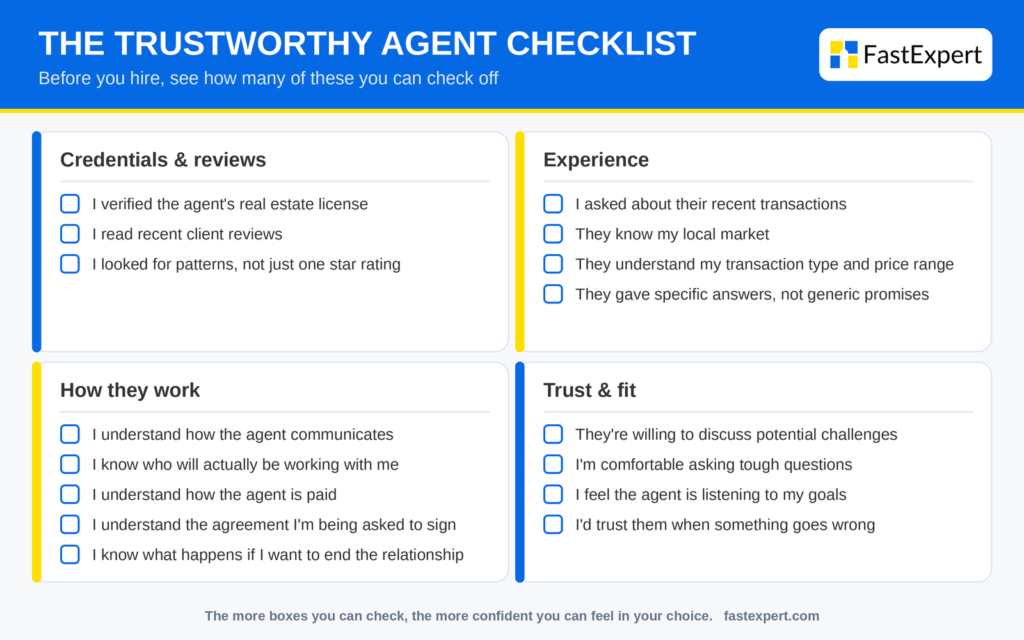
Questions to Ask Before Hiring a Real Estate Agent
If you’re interviewing agents, bring a list of questions with you. Here are some good places to start:
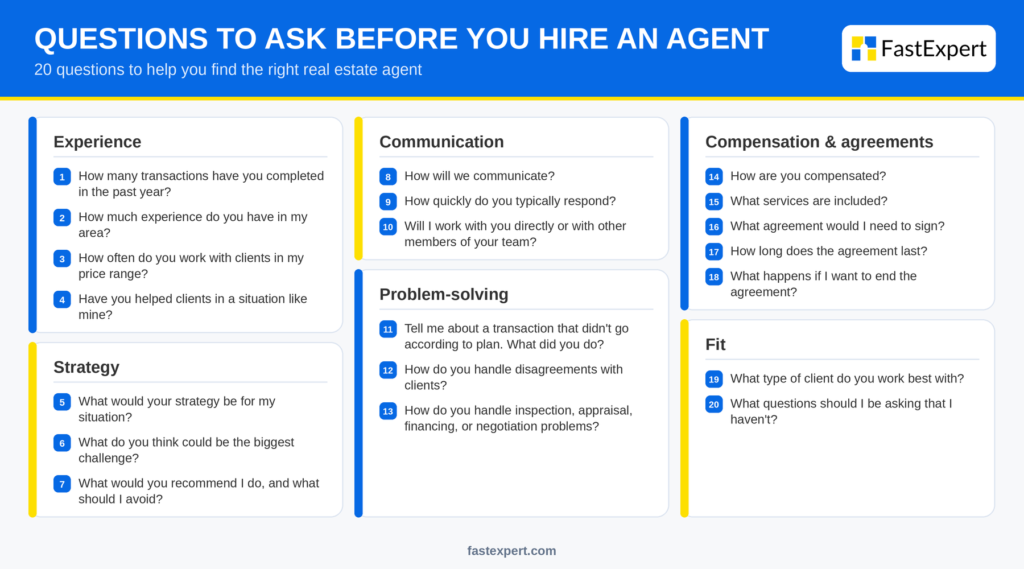
For even more interview questions, check out FastExpert’s Essential Interview Questions to Ask a Real Estate Agent.
How Many Real Estate Agents Should You Interview?
You don’t need to talk to every agent in your city. Talking with two or three qualified agents can give you useful perspective. It lets you compare communication styles, strategies, experience, local knowledge, and expectations.
FastExpert’s recent agent survey found that 93.8% of participating agents recommended interviewing two to three agents before making a decision.
Think of it less like shopping for the best agent and more like finding the best fit for your situation. The agent with the most transactions may not be the best fit for you. The newest agent in town may not be the right choice, or they might have exactly the local expertise and availability you need.
Remember, the agent charging the lowest fee isn’t automatically the best value. It’s essential to compare the whole picture.
What Makes a Real Estate Agent Trustworthy?
Ultimately, trust isn’t established by one credential, one review, or one impressive sales statistic.
It’s built through a combination of:
Transparency. The agent explains what they know, what they don’t know, and what something will cost.
Experience. They have relevant knowledge and can demonstrate how they’ve helped clients in situations like yours.
Communication. They keep you informed and respond when you need them.
Honesty. They’re willing to tell you something you may not want to hear.
Problem-solving. When something goes wrong, they focus on what can be done next.
Respect. They listen to your goals and don’t pressure you into decisions you’re not comfortable making.
And perhaps most importantly, a trustworthy agent understands that your goals are not necessarily the same as theirs.
Their job isn’t simply to get you to the closing table. It’s to help you make an informed real estate decision.
Find a Real Estate Agent You Can Trust
Finding the right agent doesn’t have to mean choosing the first person someone recommends—or trying to figure it all out on your own.
FastExpert makes it easier to research real estate agents in your area. You can compare agent experience, reviews, specialties, and other information to find professionals who may be a good fit for your needs.
Browse top-rated real estate agents in your area and find your expert agent.
Take the time to compare your options, ask questions, and choose someone you feel comfortable trusting with one of the biggest financial decisions you’ll make.
More Resources for Choosing a Real Estate Agent
- Essential Interview Questions to Ask a Real Estate Agent
- How to Choose a Real Estate Agent to Sell Your Home
- Paying Your Realtor: How Real Estate Agent Compensation Works Today
- Questions to Ask a Realtor Before Signing a Listing Agreement
- How to Contact a Real Estate Agent
You can also explore real-world answers from FastExpert agents through FastExpert Advice.
Published by